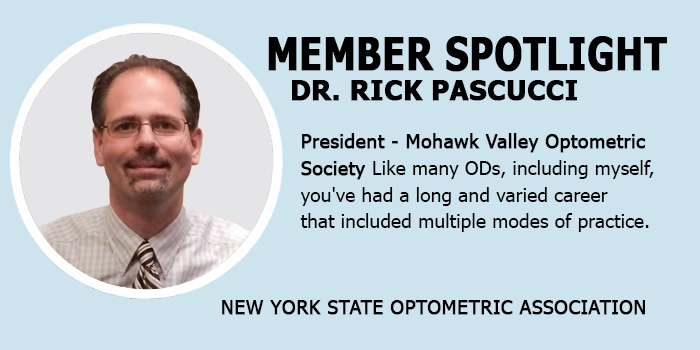
Dr. Rick Pascucci - Member Spotlight
 By Viola Kanevsky, OD
The Mohawk Valley Optometric Society encompasses a culturally and historically significant natural corridor in upstate New York that stretches through seven counties along the Mohawk River. Nestled between the Adirondack and Catskill mountains, it serves as the vital geographic link between the Atlantic coast and the Great Lakes. With only about 50 ODs serving 488,000residents, the region, like much of Central and Upstate NY, is underserved.
This month I had the pleasure of interviewing the President of the Mohawk Valley Optometric Society. Dr. Rick Pascucci grew up in Stony Brook on Long Island and completed his undergraduate studies at St. Louis University, followed by a Certificate Program in Anatomy and Neurobiology at St. Louis U. Med School. Having earned his optometry degree at Illinois College of Optometry, he worked for corporate optometry for almost 10 years and then 7 years for private OD's and MD's. 12 years ago, he purchased two established private practices, 1 in Utica and 1 in Little Falls.
Dr. Pascucci was elected Mohawk Valley Optometric Society President in 2019 and Hudson / Mohawk Trustee in 2025. He is a member of IVC Planning Committee and Trustee liaison.
Married with 4 children, 3 boys and 1 girl, Dr. Pascucci lives in Clinton, NY, volunteers with Lions Club and his local parish, and enjoys hiking, kayaking , skiing and visiting his "adult" children.
1) Like many ODs, including myself, you've had a long and varied career that included multiple modes of practice. Can you tell me a little bit about that journey, what you enjoyed and what you struggled with in different practice modalities, and which of them did you find most rewarding?
After graduating from the Illinois College of Optometry my first job was with Empire Vision (now Visionworks) in Syracuse. It was one of their busiest offices and had 3 full time doctors. It took me awhile to get up to speed with a full exam load after the comparatively light optometry school clinic schedule. I was lucky to be working with a couple of established docs that were kind enough to pick up my exam slack as I adjusted. I worked at several different Empire Vision locations for almost 10 years. After my children were born it became increasingly more difficultto work corporate hours and I looked for other options. Over the next several years I worked for a LASIK practice, a couple of ophthalmology practices, and private OD practices. Twelve years ago, 2 separately owned optometry practices located 30 minutes apart, became available forpurchase. Each practice operated at fewer than 20 hours/week. One doctor had gradually been scaling back towards retirement and the other doctor had developed a serious medical condition. I felt that neither one would work for me on its own, but together could make a full time practice. It took some time to make them my own and change certain aspects in each location, but 12years later I feel it has been the correct choice.
Every practice experience has something to teach you and something that you can bring with you as you move throughout your career - things that you feel are important to patient care and things that you never want to do again.
Corporate optometry was hardest for me mainly because of the long hours and lack of controlover how patient care was handled. Private practice has definitely been difficult as well and has its challenges all these years later, but it is also the most rewarding in terms of what I have accomplished, and how I am able spend the time with and care for my patients.
 2) Did you always practice in the Central New York area? What keeps you in the region and what can you say to students and young doctors about practicing and living Upstate, where we have a shortage of eyecare providers?
I have worked in Syracuse, as well as the surrounding suburbs, Auburn, Cortland , Ithaca. I have joked with people that I have worked on "Genesee Street" in 5 different cities. My current practices are in Utica, again on Genesee Street, and in Little Falls. I first stayed in the region because of the great quality of life and because my kids were born and being raised here. There is a lot to do especially if you enjoy outdoor activities such as hiking, biking, boating, fishing, and downhill and cross-country skiing. You just can't be afraid of the snow. I would hope that OD students and grads would give Upstate solid consideration for either employed or private practice opportunities. Many private practices in our area are looking for associates. I also hope that the new SUNY Optometry @ Upstate will help down the road in educating high quality optometric clinicians to stay and work in CNY.
3) I see from your resume that you rotated through pediatrics, low vision, and cornea and specialty contact lenses. This describes my practice on a daily basis and many doctors assume that pediatrics and contact lenses are two different fields, while low vision is all about the elderly. What ages do you care for in your practice and how do you combine these areas of expertise ?
I care for patients of all ages but my patient base definitely skews towards the older side. This is also true of low vision but a person could be visually impaired at any age due to genetic and inherited eye conditions. We typically don't schedule based on age or pathology so it keeps you on your toes when you see a peds patient and fit them for contacts and then see an elderly patient with glaucoma and AMD right after that. You have to switch gears and even your dialogue.
4) I know that you manage two private practices and have four children. Just half of that load (one practice and two kids) overwhelms me at times. What are some of the challenges and struggles you have faced in juggling all these moving parts and what wisdom can you impart to students and young ODs just starting to navigate their professional journeys? Can you describe what your days are like? Are there things you love or hate about multiple location private practice?
It was a struggle to try to bring together the way the 2 different practices functioned especially since they were owned by two different doctors. They also had 2 sets of staff who were used to doing things a certain way and change is hard. It took a while to get them to work in tandem and to have similar practice guidelines and procedures. Being a good listener to your staff and explaining why changes are being made, so that they feel part of the process and growth, can be the difference between success and failure. My staff has been an integral part of the success of the practice and none of it would be possible without their hard work and flexibility throughoutthe years.
I like the fact that if something or someone at one practice location is starting to get to me, I know within a day or two I will at least have a change of scenery at the other location and time toregroup. I dislike the fact that sometimes I have 2 sets of problems and 2 rents, phone/ internet bills, EHR etc.
Having experienced both single and multiple location models, I’ve found that each has distinct strengths, and my career has benefited greatly from exposure to both environments.
5) Please share with our readers what brought you to volunteer for organized optometry and step up to the presidency of the Mohawk Valley Optometric Society? What are your ambitions and dreams for the future- both your own and our profession's?
I was as asked to step up by the previous president of our society. Several of the other active members of the society had already volunteered their time as president and I felt it was important to try to help out and continue to further our profession. Since I became President in about 7 years ago, I have seen a lot of positive changes within the NYSOA. Obviously the Orals bill being passed was a major milestone and I love that the annual meetings at IVC, have returned after a hiatus. The annual Leadership Retreat has also been a great way to network and gain insight from colleagues and friends. I hope that other members of my local society see the value in organized optometry and volunteer. I believe that we have been and continue to be in a good place as a state society to continue to build the profession through both legislative priorities and continuing education for members. I feel there are more "wins" ahead of us if we work together - the more volunteers the better.
6) Finally, are there any final words of wisdom you'd like to impart?
I know it's cliche, but I believe that you never stop learning. Different practice modality experiences, different patient care experiences, NYSOA meetings, and of course continuing ed. all make your career fulfilling. Remember, sometimes you learn the most from bad experiences, mistakes, and even failures. Take those experiences, move on and improve.
Dr. Julie Song - Member Spotlight
Even now, as a practicing optometrist, her passion is unmistakable as she notes that she loves talking about eyes