Dr. Emily Gottschalk - Member Spotlight
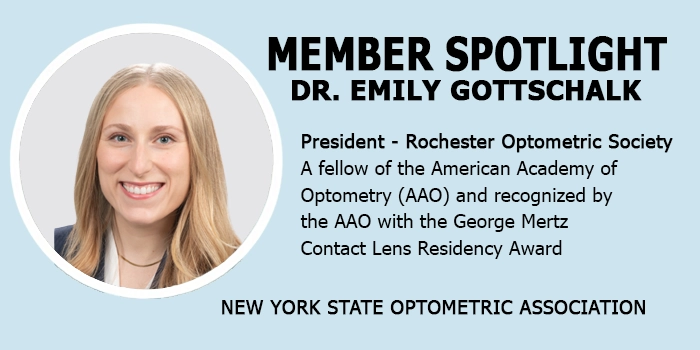
 By Viola Kanevsky, OD
The Rochester Optometric Society provides programming to the counties of Monroe, Genesee, Livingston, Ontario, Seneca, Wayne, and Yates. Located in the Finger Lakes region of NYS, Rochester evolved as a flour-milling "boomtown", and later a global powerhouse for optics, photography, and civil rights. It boasts 191 registered optometrists.
This month I had the pleasure of interviewing the Society's president, Dr. Emily Gottschalk. Dr. Gottschalk graduated from the University of Waterloo School of Optometry and Vision Science and completed a Cornea and Contact Lens Residency at the Michigan College of Optometry. She is originally from Toronto, Canada, and currently practices at Rochester Regional Health Eye Care, a hospital-based OD/MD practice in Rochester, NY. There she utilizes her residency training to fit the full range of medically necessary contact lenses, manage ocular surface disease, and provide comprehensive eye care to her patients.
A fellow of the American Academy of Optometry (AAO) and recognized by the AAO with the George Mertz Contact Lens Residency Award, Dr. Gottschalk is a diplomate of the American Board of Optometry and a participant of the American Optometric Association Leadership Institute.
1) Having graduated many years ago, I myself had several classmates at SUNY who hailed from Canada. At that time, there were only two Canadian schools and one was French speaking. Our Canadian students were brilliant and I always imagined the ones who managed to stay in Canada and finish optometry school there, were even more awesome.
Can you tell me what it was like to study in Waterloo, and how the curriculum and practice of optometry differs from the U.S.?
Waterloo was an incredible experience. It is still the only English-speaking optometry school in Canada, which means students come together from every province. I graduated with colleagues that now practice from Vancouver to Halifax, coast to coast. Many of us are still in touch, comparing notes and sharing resources across provinces and, now, across the border. As for curriculum and scope, from what I saw during my residency at the Michigan College of Optometry, the training itself is quite comparable, and day-to-day scope of practice is similar, too.
2) Almost all of my Canadian classmates returned to Canada to practice. What made you come to the states?
I looked towards US residencies to broaden my experience following optometry school. I was limited during the application cycle because there were only two programs that were able to sponsor a visa for a Canadian who hadn't completed a US degree. Everything fell into place when I matched at the Michigan College of Optometry. During residency, I learned US billing and coding and started building a professional network here. My original plan was to return to Canada afterward but with the momentum I had built during residency, I decided to explore opportunities in the US.
3) I see from your resume that we share a love of pediatrics and custom contact lenses. For me, the fascination lies in the pleasure of play while granting the gift of sight. What do you love about our profession and what drives you to pursue excellence?
The beauty of optometry, and medically necessary contact lenses in particular, is that we are in the business of giving good news. Whether it's fitting a pediatric patient for contact lenses that allow them to freely participate in sports or fitting a medically necessary lens for a patient who has no other path to clear vision, it's a specialty that's optometry-specific, and has a substantial impact on patients' quality of life. That is what drives me to pursue excellence. The more I hone my skills, the more patients I can give that gift of sight.
4) I know that you work in a multidisciplinary setting. Many of our older colleagues are accustomed to practicing solo. In the thirty plus years of my career I have watched as optometrists have become more and more comfortable working side by side with MDs. What are some of the challenges and struggles you have faced since graduation and what wisdom can you impart to students and young ODs just starting to navigate their professional journeys? Can you describe what your days are like? Are there things you love or hate about working with other professions in a hospital-based clinic?
One of the reasons I was attracted to my current position was the multidisciplinary setting. Working alongside ophthalmology, specifically cornea, meant access to patients who could benefit from my training in medically necessary contact lenses. Patients also benefit from the ease of referral within the system. Many of my patients come from primary care, neurology, rheumatology, endocrinology, and ophthalmology.
A typical day for me is a mix of comprehensive care and medical management, specialty contact lens patients woven throughout, and same-day referrals from acute care or walk-ins. There is a lot of variety in a day and no two days look quite the same, which keeps the work interesting.
What I love about working in a hospital-based clinic is that I am always learning from many knowledgeable optometrists and ophthalmologists. What can be hard about working within a large system is that things move slowly and change can take time.
My advice to new ODs entering a multidisciplinary setting is to build relationships with the care team through consistent communication with other providers. This helps to build trust in how you co-manage patients.
 5) I believe you have supervised students, lectured, consulted, and worked in direct patient care. Do you have a favorite?
My background is actually in research. Before I started my optometry journey, I was a research coordinator at The Hospital for Sick Children in Toronto. My supervisor was a physician who wore many hats including clinician, educator, researcher, lecturer, even health-tech consultant. The variety in his days fascinated me. I had an interest in optometry at the time, and set out to find whether a career like that existed in this field. I learned quickly that residency in optometry opened these doors.
During residency, I precepted in the contact lens clinic. Since then, I have lectured on contact lens topics, built relationships with contact lens labs who have invited me back to lead workshops, and write a column for the Contact Lens Spectrum. I have also gotten involved in advocacy through my work with the local and state associations.
So if you're asking me to pick a favorite, I will go with the bread and butter, direct patient care. But the real theme here is that you do not have to pick just one. Optometry can offer a diverse, exciting career depending on what you're looking for.
6) Please share with our readers what brought you to volunteer for organized optometry and step up to the presidency of the Rochester Optometric Society? What are your ambitions and dreams for the future- both your own and our profession's?
My passion for optometry and advocacy has always been self-driven, but I am grateful to the mentors who recognized that in me and empowered me to get involved. First with the Rochester Optometric Society, and now, this coming year, in the NYSOA Regional Trustee role. On both the state and local levels, I have had a very supportive board around me, with decades of combined experience in organized optometry and advocacy to learn from.
In the time I have practiced in New York State, I have directly benefited from the work of organized optometry including the oral medications bill, which allows me to practice to the full scope of my education every day.
My dream for the future is to keep empowering new ODs to get involved in whatever aspect of professional development interests them, whether that's advocacy, education, research, or patient care. More broadly for the profession, I would like to see us continue pushing scope expansion, every step forward means better patient access to optometric care.
 7) Finally, are there any final words of wisdom you'd like to impart?
Get involved early. You will continue to learn, meet people, and build a career you are excited about. Along the way, find a mentor, then become one, that's how this profession keeps growing.
Dr. Julie Song - Member Spotlight
Even now, as a practicing optometrist, her passion is unmistakable as she notes that she loves talking about eyes