Dr. Julie Song - Member Spotlight
By: CDC Newsletter
 During college, Dr. Julie Song had the opportunity to shadow providers across several healthcare fields. While each experience was valuable, optometry stood out the most largely because the optometrists she observed were genuinely happy. She recalls noticing that they “clearly wanted to be there” and that there was “so much longevity in the field.” She was also drawn to the fact that many optometry offices were willing to hire students as technicians, offering early hands-on experience. Most notably, Dr. Song was struck by the level of mentorship within optometry, something she did not experience as strongly in other fields she explored. That mentorship ultimately played a key role in drawing her to the profession.
Even now, as a practicing optometrist, her passion is unmistakable as she notes that she loves talking about eyes to anyone who asks even on her “time off.”
Before starting at SUNY Optometry, Dr. Song worked in a cornea and contact lens practice in Tucson, Arizona, where she cared for a large population of keratoconic patients. This experience was truly where she fell in love with the field, and with contact lenses in particular.
Although she entered SUNY knowing she had a strong interest in contact lenses, Dr. Song intentionally explored all modalities of optometry. She credits SUNY for offering exposure to multiple subspecialties, allowing her to confidently choose a path she could see herself in long term. She is also grateful for the support of her mentors and classmates throughout her time as a student. During her years at SUNY, the micro-credential program was still in its early stages, and Dr. Song specifically acknowledges the mentorship of Dr. Sharon Keh, whose guidance helped her realize that a contact lens residency was the right fit for her.
Contact lenses appealed to Dr. Song because of the fast-paced, problem-solving nature of the field. The opportunity to design scleral lenses and prosthetics also allows her to tap into her creative and artistic background. Growing up, she explored a wide range of mediums, including oil pastels, watercolors, and painting which she still utilizes today. These combined passions ultimately led her to match into a contact lens residency.
While she notes that “the journey to residency is always difficult, no matter what,” Dr. Song emphasizes that it is an incredibly rewarding opportunity for students who are eager to learn and grow. The training, she says, is worth its weight in gold. The networking opportunities alone have been unparalleled, opening doors to lecturing and authoring articles. She shares that the speed and frequency with which these opportunities came would not have been possible without her residency training.
For students interested in pursuing a specific residency, Dr. Song stresses the importance of intentionally placing yourself in that space. This can be through processes such as taking on additional shadowing shifts or clinical experiences. “Doing what you genuinely love,” she says, “is key.”
For those who may feel apprehensive about networking, Dr. Song offers practical advice: “Shed your fear and really put yourself out there.” While it may sound simple, she acknowledges it can be difficult in practice. She recommends attending events with one or two friends at most so you have an opportunity to shine. For example, if you’re interested in public speaking, introduce yourself to speakers who you have heard present before and admire, those conversations may later turn into opportunities. Ultimately, she emphasizes that opportunities come when preparation meets clinical experience; people want to hear about the cases you’ve managed and the insights you bring.
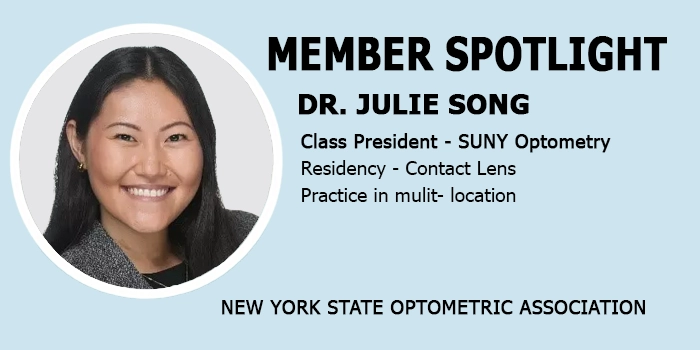
In addition to her work in contact lenses, Dr. Song served as class president during her time at SUNY Optometry. While the role was emotionally and physically demanding, she deeply valued her class and was committed to advocating for them. Through this experience, she gained essential skills such as people management, problem-solving, and not being afraid to speak up and navigate professional relationships. These were critical skills she uses daily after graduation. Dr. Song notes the importance of developing these soft skills to be a successful optometrist in any opportunity you can as it is not always explicitly taught in optometry school.
Today, Dr. Song practices at a multi-location ophthalmology group across several boroughs, where she provides specialty contact lens care in addition to comprehensive eye examinations. Outside of clinic, she stays just as busy, spending her free time reading (she read 126 books last year!), creating art, and baking.